
December 06, 2019 ✒ Andrew Kantor
A nifty study out of UGA (and the Oak Ridge Associated Universities) found that a dose of virtual reality — showing people how the flu can spread — can encourage them to vaccinate. Compared to video or the e-pamphlet, the VR condition created a stronger perception of presence – that is, a feeling of “being there” in the story, which, in turn, increased participants’ concern about transmitting flu to others. This increased concern was associated with greater confidence that one’s flu vaccination would protect others, more positive beliefs about flu vaccine and increased intention to get a flu vaccination. Artist’s conception More than you think — specifically (at least according to researchers at Case Western Reserve University) the issue is inflammation. While higher BMI is often associated with a greater risk of gum disease, it’s not cause-and-effect. Rather, it seems that what causes one might cause the other. They concluded that changes in body chemistry affect metabolism, which, in turn causes inflammation—something present in both maladies. “Periodontal disease occurs in patients more susceptible to inflammation—who are also more susceptible to obesity.” Will you be taking your Georgia licensing exam later this year? Do you know someone who will? (Maybe a graduate? Maybe a pharmacist moving to Georgia?) Then brush up on the practical skills you need to have. GPhA’s crazy-popular program — the “Practical Skills Refresher Course” — is coming in 2020 on four days in four locations. It’s a concentrated, four-hour refresher on terminology, measurements, and the procedures you’ll put into practice. You can just imagine how useful this will be. NEW: Labs! For 2020 we’ve added “Practical Skills for the Lab” — lab time with an instructor to watch you and provide feedback, in a simulated testing environment. If you’re a student pharmacist or a transfer to Georgia, you want this course. You NEED this course. Click here for more info and to register NOW! Washington State University researchers asked people to report if they used inhaled cannabis (i.e., if they smoked pot) to deal with a headache. What they found — and obviously take this with a grain of salt, because it was self-reported: Said the researchers, “This at least gives medical cannabis patients and their doctors a little more information about what they might expect from using cannabis to manage these conditions.” Although aspirin may have lost some of its luster as a heart-disease preventer, yet another study shows that seniors who take it regularly — three or more times a week — “were 15 percent less likely to die from their disease than those who didn’t use it at all.” Caveat: This only applies to prostate, lung, colorectal, or ovarian cancers. But still. Bladder cells come with a great protein receptor that can be used to treat cancers there. The trouble is, in cancerous cells those receptors don’t always work. So Purdue University researchers combined the typical bladder-cancer-fighter with anthrax, because the toxin doesn’t need those (missing) receptors. It can get into the cancer cells on its own. With this combination, the authors “efficiently targeted and eliminated human, mouse, and canine bladder tumor cells.” Importantly, the beneficial effects occurred within minutes, rather than hours. We’re still in the middle of the carcinogens-in-Zantac scare, and now the FDA is looking at the supply lines for generic metformin, concerned that the same carcinogen might be affecting those meds as well. We’ll keep you updated. “Why your generic drugs may not be safe and the FDA may be too lax” Are generics safe? If drug manufacturers followed the FDA’s strict regulations, the answer would be a resounding yes. Unfortunately for those who turn to generics to save money, the FDA relies heavily on the honor system with foreign manufacturers, and U.S. consumers get burned.VR flu scare, is metformin the next Zantac?, generic safety worries, and more
The (virtual) reality of flu

What do obesity and gum disease have in common?
Practical Skills Refresher Course — now with labs!
Pot v. headache
Aspirin v. cancer
Anthrax v. bladder cancer
FDA worries about metformin
The Medium Read: Generic-drug safety
December 05, 2019 ✒ Andrew Kantor
Pills for pigs, the flu warning, dyeing for hair, and more The federal government will begin offering free HIV-prevention drugs to anyone without insurance, thanks to a deal it made with Gilead (the drug maker) as well as with CVS, Rite Aid, and Walgreens (which have agreed to dispense the drugs free). Caveats: Patients are responsible for obtaining a prescription for the PrEP (pre-exposure prophylaxis) drugs and for getting an HIV test, which can cost up to $1,000 per year — remember, these are people without insurance. But if the test is negative, patients can call (855) 447-8410 or visit getyourprep.com to apply for the free drugs. Gilead is charging the government $200 per bottle, which is claims is the cost of transporting it from factories to pharmacies. That price may drop after March 30, by which time the government hopes to find a less expensive distributor. Apparently some permanent dyes and hair straighteners can increase a woman’s* chance of getting breast cancer. Regular use for a year meant an average 9% higher risk — on average. For African-American women, that risk was much higher: Among African American women, using permanent dyes every five to eight weeks or more was associated with a 60% increased risk of breast cancer as compared with an 8% increased risk for white women. Good news: “The research team found little to no increase in breast cancer risk for semi-permanent or temporary dye use.” Great news if you don’t want your pig to get pregnant: Scientists have tested the first monthly contraceptive pill on pigs. What’s cool: It’s designed to implant itself in the digestive tract and slowly release its medication over weeks. First: Researchers at Cambridge University, UC San Francisco, and biotech company SomaLogic, have developed a blood test they believe can predict a patient’s likelihood of developing a range of diseases. No, this is not a repeat of the Theranos debacle — this technique uses real science and has published results. Because certain DNA fragments (aptamers) can only bind to certain proteins, the researchers look to see what aptamers are present. That info is then fed into machine learning algorithms and used to predict things like the patient’s risk of developing diabetes or cardiovascular disease. It’s still proof-of-concept, and it’s meant to assist physicians in health screenings — not to be And: Scientists at the University of East Anglia in the U.K. believe they have a simple urine test to detect prostate cancer. “Because the [Prostate Urine Risk] test accurately predicts aggressive prostate cancer, and predicts whether patients will require treatment up to five years earlier than standard clinical methods – it means that a negative test could enable men to only be retested every two to three years, relieving stress to the patient and reducing hospital workload.” “One hospital had 9 flu cases at this time last year. This year, it has more than 1,400” 37 percent of Americans don’t plan on getting a flu shot. Drinking milk, it seems, doesn’t help you live longer*. “Total dairy intake was not associated with lower risk of total mortality,” lead study author Ming Ding of the Harvard School of Public Health in Boston and colleagues write in The BMJ.Pills for pigs, the flu warning, dyeing for hair, and more
“Free” HIV drugs, courtesy of HHS
Why not to dye
Pig contraception
Testing, 1, 2, 3
This headline shows why your patients need to worry about the flu
Sadly, the message isn’t getting through
Mom was wrong
December 04, 2019 ✒ Andrew Kantor
About 20 percent more Georgians are signing up for medical coverage through the Affordable Care Act marketplace than last year — likely due to lower, stable premiums and more choice of carriers. About 481,000 people in the state got their coverage through that marketplace in 2019. Reminder: Now is the time to nominate someone you know (maybe even yourself) for a 2020 GPhA award. Four of them will be presented at the 2020 Georgia Pharmacy Convention — check out the details and nominate someone at GPhA.org/awards! Heck, while we’re on the subject of deadly bacteria, guess what? The deadly Candida auris “superfungus” has been found in Georgia! So far, luckily, it’s just a single confirmed case, but Candida auris is resistant to most antifungal drugs, and it’s got a 33 percent mortality rate. Not just one or two, though. Research out of Florida Atlantic University suggests that ultra-high doses — we’re talking 900 to 1,300 mg (i.e., three or four standard tablets) — “is an effective and safe treatment option for acute migraine headaches.” Yesterday we told you how the U.S. is unique among modern nations in having our life expectancy going down. Here’s another cause of that decline: liver disease. Thanks to increasing alcohol abuse, mortality from liver disease has been going up, especially among people aged 55-64 living in rural areas. You know how drug makers justify their high prices by claiming they need the money for research and development? A former sales rep explains why that simply isn’t true: “For every dollar the pharmaceutical industry spends on research and development, it spends two on marketing.” And then he explains how the goal is to push physicians to prescribe, prescribe, prescribe. Sometimes, you’re better off not knowing something — like exactly what happens in a restaurant’s kitchen. The same is true, it seems for what’s lurking in a makeup bag. But researchers at Aston University in Birmingham, U.K., were not deterred. They looked at the bacteria in those bags, and they published the results in the Journal of Applied Microbiology. Bacteria that can cause illnesses ranging from skin infections to blood poisoning if used near eyes, mouth or cuts or grazes were found in nine out of ten of the products. This risk is amplified in immunocompromised people who are more likely to contract infections from opportunistic bacteria. The idea of talcum powder being contaminated with asbestos isn’t new. In fact, the issue has been raised often in the past half a century. The problem: Relying on industry to police itself, instead of having government regulation. Read “Powder Keg: FDA bowed to industry for decades as alarms were sounded over talc” Over the past 50 years, the FDA has relied upon – and often deferred to – industry even as outside experts and consumers repeatedly raised serious health concerns about talc powders and cosmetics, a Reuters investigation found. Again and again since at least the 1970s, the agency has downplayed the risk of asbestos contamination and declined to issue warnings or impose safety standards, according to documents produced in court proceedings and in response to public records requests.Superbug, mega aspirin, opportunistic bacteria, and more
Obamacare signups are up
Who deserves it?
Georgia gets a superbug
Aspirin for migraines?
Trying to get away
Two for one spending
Eew
The Long Read: Talc and asbestos
December 03, 2019 ✒ Andrew Kantor
Forget the pharmaceutical side — if you’re confused about the legal status of CBD products, you’re not alone. Thanks to the nationwide legalization of hemp*, CBD oil has appeared all over the place. “Sales of CBD have nearly quadrupled since 2015 and they’re projected to hit $1.8 billion by 2022,” reports the Washington Post. And while some studies have shown that CBD oil seems to help some health conditions, there hasn’t been any kind of major, detailed study. That hasn’t stopped the marketing folks from promising miracles, though … but very carefully. (They can’t actually say that CBD treats a particular disease or condition. They leave that to the rumor mill that is “Dr. Facebook.”) But the FDA has just now made one thing very clear: It is illegal to sell foods or beverages that contain CBD. You see, the FDA doesn’t regulate supplements other than to keep them from being sold as cures. But it does regulate foods, and it has not determined that CBD is “generally recognized as safe” — ergo, keep it out of food. And that announcement has some companies — those that are ready to pump their products full of CBD — left waiting. Brands like Ben & Jerry’s, Unilever and Anheuser-Busch have announced CBD products in development, and stores such as Walgreens, Kroger and CVS have vowed to sell them. Generic-drug manufacturer Cipla has developed a strawberry-flavored AIDS treatment for infants, which the company said it will sell for $1 per day per child (less for newborns). If approved by the World Health Organization, it could save 80,000 lives per year. Down: U.S. life expectancy for the third year in a row, making us the only wealthy country to have this happening. The biggest culprits: 25-64 year olds, thanks to overdoses, obesity, and suicide. “We may think we have best medical care in world and highest life expectancy … but that’s not the case.” Down: Abortions in the U.S. — a 2% percent drop in 2016 over the year before, and a 24 percent drop over the last 10 years. Down: Births in the U.S. for the fourth year in a row, including a 7% drop in teenage births from 2017 to 2018. The country’s birth rate is at a record low, and is “below what’s needed for the population to replace itself.” Patients taking the anticoagulant coumadin (aka Warfarin) might find their risk of fracture is increased — especially if they also take apixaban (aka Eliquis). And patients taking statins, even for just a few months, have an increased risk of developing diabetes and skin infections. The researchers found statins to be associated with a significant risk for SSTIs. The greatest risk was found to be associated with statins atorvastatin and simvastatin. Amazon has been dipping its various toes into the pharmacy space — a license here, a PillPack acquisition there. If you haven’t paid attention, you might want to read “Amazon’s plan to dominate the pharmaceutical industry is taking shape” for a bit of an overview … and possibly a preview of the future. Life insurers may start treating vapers like smokers — raising premiums or refusing to insure them at all. Living near an irregularly-shaped park is better for your health than living near one with a simple shape. “We showed that the complexity of the park shape was positively associated with a lower risk of mortality,” they said in the paper. “This association might be attributable to the increased number of access points provided by complex-shaped green spaces.” A bill in Massachusetts would allow pharmacists to dispense 72-hour emergency supplies of insulin to patients. The state legislature there already passed a bill excluding insulin from insurance deductibles.Unexpected side effects, what Amazon’s up to, avoiding boring parks, and more
CBD: Supplements OK, food illegal
Some great AIDS news
Down, down, down
Side effects
Amazon in pharmacy
Vaping twist
Medical stories that make you go “Huh”

Elsewhere: Bay State Edition
November 27, 2019 ✒ Andrew Kantor
Apparently there are some issues with the fed’s new Medicare Plan Finder — specifically, it may say some drugs are covered by a plan … but they really aren’t. Something to be aware of if a patient tells you, “But I know that’s covered!” One in three (!) Americans under 65 who are prescribed heart meds either skip pills, lower their dosage, or don’t fill their prescriptions because of the cost. (Among Medicare patients, that number is about one in nine.) That’s about 2.2 million Americans, or 12.6% who can’t afford their medication. “Despite decades of evidence showing the effectiveness of medications like blood pressure lowering drugs and cholesterol lowering statins, none of these drugs can have an opportunity to work unless the patient can afford them.” The new class of migraine meds block a neuropeptide that can cause headaches, but that same peptide (αCGRP) is critical for the heart. Without it, physical activity doesn’t do the heart much good. Ergo, “New migraine meds are risky for people with high blood pressure.” From Drugs.com: “Overall Rate of Pediatric Nonpowder Firearm Injuries Down” From US News: “Dramatic Rise in Eye Injuries From BB and Paintball Guns” The reality: Overall kids’ injuries from BB guns are down, but eye injuries are up. So yes, kids, you really will shoot your eye out. The clickbait: “Cannabis tied to severe heart attack risk in younger adults”. The actual story: “Teens and young adults who use cocaine, amphetamines, and cannabis are more likely to be hospitalized for heart attacks.” Polio is now so rare that more cases are caused by the cheaper, live-virus vaccine than by the disease in the wild. (That’s the oral vaccine that’s used in poorer countries; in the West we use an injectable vaccine with an inactive virus.) The Accreditation Council for Nutrition Professional Education, the American College of Nutrition, the American Nutrition Association Foundation, the Board for Certification of Nutrition Specialists, and the Center for Nutrition Advocacy have joined themselves, Voltron-style*, to form the mighty American Nutrition Association. In case you missed this bit of medical news: Shaking your head to get water out of your ear can cause brain damage. “Diabetic foot wounds kill millions, but high-tech solutions and teamwork are making a difference” [W]ith more and more people being diagnosed with Type 2 diabetes earlier, there is a population that is younger than ever being afflicted with wounds, infections and amputation. Ignoring the problem is an example of ignoring the needs of a silent and vulnerable population. This Thanksgiving, your humble* Buzz writer would like to say thank you — thank you to everyone who has let this little newsletter into your inboxes, opened the messages (and sometimes clicked on a link or two). Thank you for putting up with bad puns, obscure references, the mild* dose of cynicism, and the occasional misguided sense of humor. Knowing you’re out there† keeps the Buzz engine going!BB injuries, don’t shake your head, fighting diabetic foot wounds, and more
If you have patients on Medicare, you might want to know about this
Oddly, other places don’t have this issue
Migraine med danger
One study, two spins

And while we’re on the subject of headlines….
Polio news
From many, one
Stirred, not shaken
The Long(ish) Read: Diabetes and “Smart boots, high-tech vacuums and sheets of stems cells”
Thank you
November 26, 2019 ✒ Andrew Kantor
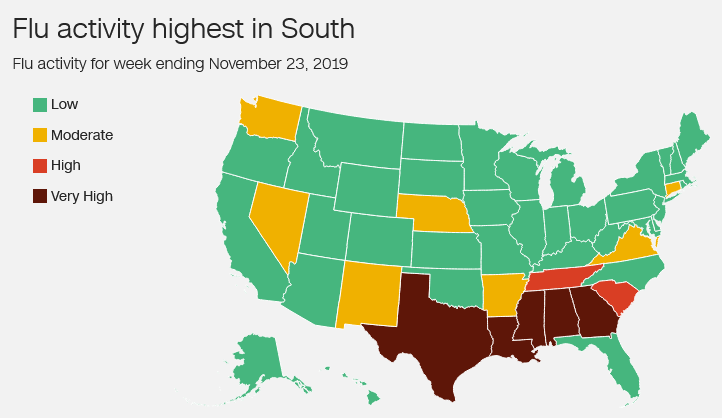
Georgia is now one of seven states, plus Puerto Rico, where flu activity is the highest. The bad news: Nearly 5,000 Americans have been hospitalized due to the flu so far this season. The sort-of good news: That number is similar to previous years (meaning maybe this season won’t be quite so horrific). Cancer patients who take radiation therapy might have some brain damage — mild, but enough that for kids it can cause “difficulties learning or socializing and even holding down a job later in life.” The answer could be lithium. A study out of Sweden found that lithium seems to help reduce that radiation damage. Although they aren’t entirely sure how it works, it appears to foster the creating of new neurons in the hippocampus … but only within areas that were irradiated. “From this, we conclude that lithium, given along the lines of this model, can help to heal the damage caused by radiotherapy, even long after it was caused.” People with type 1 diabetes should avoid using marijuana regularly. Anything more than occasional use make them “more than twice as likely to develop potentially fatal complications,” specifically diabetic ketoacidosis. On the other hand… People suffering from migraines (or other headaches), found that inhaling cannabis reduced those symptoms by almost half. Interestingly, those results came via an app developed by Washington State University to track just that kind of effect. Coincidentally echoing the vaping industry’s talking points, Donald Trump said he backtracked on his promise to have the FDA ban flavored vaping products because he was concerned it would only cause teens to turn to unregulated products on the black market. Proponents of a ban point out that, with teenage vaping and nicotine addiction skyrocketing, it’s better to make it harder for kids to get these products than to do nothing. Could being overweight be good for you? Maybe so. A new study out of Denmark looked at more than 35 years of body-mass index and mortality and concluded that, as cardiovascular risk has decreased, “the BMI associated with lowest all-cause mortality may have changed.” What those shifty Danes found is that the sweet spot for BMI might actually be “overweight” — that is, between “normal” and “obese.” (Specifically, a BMI between 25 and 29.9.) [T]hose in the ‘obese’ category ended up having the same risk of death as those in the ‘normal’ range, even when factors such as age, sex, family history of disease, socio-economic status, and smoking were taken into account. This means that in the past 40 years, the weight category associated with the longest lifespan has gone from ‘normal’ to squarely in the ‘overweight’ camp. Donald Trump has again said that Americans will be able to import drugs from Canada (taking advantage of the government price regulation there). Unfortunately, the Canadians have already said “No*.” Besides, the current plan would only allow states to ask the feds for permission to import drugs … before being rejected by Canadian authorities. Don’t eat any Romaine lettuce. No, this is not a repeat from 2018. Larger may be better, lithium beats brain damage, another romaine recalls, and more
F.L.U. in the U.S.A.
Lithium post-radiation treatment
Cannabis ups and downs
Quick vaping-flavor update
Krispy Kreme, here we come
Is this thing on?
ICYMI
November 23, 2019 ✒ Andrew Kantor
And almost 2300 people have been hospitalized. That is all. The good news: Smoking in America is at an all-time low. The bad: One in seven still does, according to the latest CDC figures. Those shifty Danes have found a new and somewhat surprising way bacteria become resistant to antibiotics. Like some plants do, bacteria under attack can send out warning signals to other bacteria. The bacteria that receive those signals will then avoid the area with the antibiotic (or the bacteriophage), in what one researcher called “a smart survival mechanism for the bacteria.” Could, yes, at least according to a Finnish study. What’s the connection? Heavy use of antibiotics can disrupt the gut microbiome enough that it leads to the disease. The link between antibiotic exposure and Parkinson’s disease fits the current view that in a significant proportion of patients the pathology of Parkinson’s may originate in the gut. It looks to be an entirely new kind of antibiotic, attacking cells in a different way than existing drugs. Darobactin binds to the BamA protein, located in the external membrane of gram negative bacteria. As a result, the establishment of a functional external membrane is disrupted and the bacteria die off. “It is particularly interesting to note that this previously unknown weak point is located on the outside of the bacteria where substances can easily reach it.” If you have patients looking to lose weight, there are a lot of ways to do it. Pro tip: Diet pills or laxatives are not a good one. It’s not just the potential for liver and kidney damage. There’s also a higher risk of ending up with an eating disorder. [U]se of these products for weight control may serve as a “gateway” to further disordered eating practices by dysregulating normal digestive function and fostering dependence on unhealthy and ineffective coping methods. A new antibiotic, fewer smokers, bacterial conversations, and more
Vaping deaths hit 47
Future cancer patients of America
Bacterial warnings
Could antibiotics lead to Parkinson’s?
Meet darobactin
Losing it the smart way
November 22, 2019 ✒ Andrew Kantor
Will you be taking your Georgia licensing exam later this year? (Know someone who will? Maybe a graduate? Maybe a pharmacist moving to Georgia?) Then brush up on the practical skills you need to have. GPhA’s crazy-popular program — the “Practical Skills Refresher Course” — is coming in 2020 on four days in four locations. It’s a concentrated, four-hour refresher on terminology, measurements, and the procedures you’ll put into practice. You can just imagine how useful this will be, especially if you’re taking the wet labs exam. NEW: For 2020 we’ve added “Practical Skills for the Lab” — lab time with an instructor to watch you and provide feedback, in a simulated testing environment. If you’re a student pharmacist or a transfer to Georgia, you want this course. You NEED this course. Click here for more info and to register NOW! In the U.S., the job with the highest salary requiring the least amount of experience is … pharmacist. (Before your hackles get raised, keep in mind that this simply means they get paid the most right out of school. “No experience” doesn’t mean “easy.”) While pharmacists often rank high on top-paying jobs lists, the high salary comes only after years of education, which includes training in a learning environment. […] students must earn a four-year doctoral or professional degree and complete a series of clinical rotations within their program before being able to practice. Ah, the Sackler family — the folks of Oxycontin fame. Even as they face billions of dollars’ of lawsuits here over how they pushed opioids and helped create the current crisis, they are trying the same tactics … in China. Check out “Fake doctors, misleading claims drive OxyContin China sales“. [R]epresentatives from the Sacklers’ Chinese affiliate, Mundipharma, tell doctors that time-release painkillers like OxyContin are less addictive than other opioids—the same pitch Purdue admitted was false in U.S. court more than a decade ago. Mundipharma has pushed ever larger doses of opioids, even as it became clear that higher doses present higher risks, and represented the drug as safe for chronic pain, according the interviews and documents. It seems that good ol’ statins, while helping reduce cholesterol, can also reduce men’s risk of contracting the more aggressive type of prostate cancer. [T]here were no differences in the overall rates of prostate cancer among men who were prescribed statins. However, men who had taken statin medicines had a 24% reduced risk of developing a more lethal type of prostate cancer when compared to men who were not. Yes, yes, this is a serious medical story. But come on, if your mind didn’t go to the humor possibilities, you need to get out more. Some children with serious brain issues might have literally half their brains removed — and still grow up to function in society*. Only now are scientists beginning to understand how that’s possible. It was almost as if parts of the brain that may have normally been specialized, say, as trumpet players, had talked to the rest of the band and taken additional responsibilities to play percussion instruments as well. “Their brain networks seem to be multitasking.” Medbelle’s 2019 Medicine Price Index looked at 13 common medications and their prices across 50 countries. It found that… Although it’s being overshadowed by other events on Capitol Hill, FDA commissioner nominee Stephen Hahn’s confirmation hearing is in progress, and it seems to be fairly non-controversial. Hahn “stuck to the script” for the most part, pledged this and that, and in general seems to be qualified for the job. The only issue that arose was Hahn’s refusal to commit to banning flavored e-cigarettes — a policy with support on both sides of the aisle. Hahn demurred when asked if he would push Trump to issue regulations banning e-cig flavors, but told Sen. Mitt Romney, R-Utah, that he was “alarmed” by data showing a widespread uptick of teenage vaping and supported “bold action.” The FDA has dropped its plan to require cigarette makers to lower the amount of nicotine in their cigarettes. Joe Grogan, the head of the White House Domestic Policy Council*, earlier this month called the FDA’s regulation of tobacco “a huge waste of time” and said the agency should focus on pharmaceuticals. On the other hand… Former FDA commissioner Robert Califf said on Twitter that the change marked “a sad day for future grandchildren. They will have fewer grandparents because of this.” For the first time, humans have been placed in suspended animation. Suffering from major trauma (including cardiac arrest) and not expected to survive surgery, they were cooled to about half their normal body temperature, and — hold onto your hats — had all their blood replaced with ice-cold saline. That gives surgeons extra time to operate. Sounds pretty impressive, right? The initial was on 10 people, but … the doctors aren’t saying how many of them survived. Animal studies showed that pigs with acute trauma could be cooled for 3 hours, stitched up and resuscitated. “We felt it was time to take it to our patients,” says [researcher Samuel Tisherman of the University of Maryland School of Medicine]. “Now we are doing it and we are learning a lot as we move forward with the trial. Once we can prove it works here, we can expand the utility of this technique to help patients survive that otherwise would not.” Half brains and full lives, FDA backs off on nicotine, the Sacklers go to China, and more
Open now: Practice Skills Refresher Course (now with labs!)
Did you know?
How low can they go?
Statins and prostate cancer
I’ve got half a mind….
Same old song
All quiet on the nomination front
Nicotine: As you were
Cool* medical news
November 21, 2019 ✒ Andrew Kantor
There was a six-hour burglary spree of pharmacies in the Atlanta area (Dacula, Duluth, Decatur, Buford), and the criminals are still at large. “Police fear the burglary spree will continue across metro Atlanta until the suspects are caught.” Authorities released these helpful images: This flu season is probably gonna be a doozy. Australia (which gets it first) called it “particularly unusual,” “off the charts,” and a “horror season.” Now is when you need your APhA immunization certificate. It means you’re giving your patients the best possible advice and treatment, and it helps you differentiate yourself. GPhA is offering “APhA’s Pharmacy-Based Immunization Delivery: A Certificate Program for Pharmacists” on Sunday, December 8, from 8:00 a.m. – 5:00 p.m. in the GPhA classroom (6065 Barfield Road, Sandy Springs [map]). This is always one of our hottest courses, so get to GPhA.org/2019immunization fast before the class fills! And don’t forget to check out all of GPhA’s CPEasy on-demand courses at GPhA.org/cpeasy! A Harvard doc did the research, and says that, “the rate of opiate prescriptions is lower in states where medical marijuana laws have been passed.” Meanwhile, a study from the University of British Columbia found that people who use cannabis daily are less likely to use illegal opioids. They found that daily cannabis use was associated with significantly lower odds of daily illicit opioid use, suggesting people are replacing opioids with cannabis to manage their pain. Back in August, the FDA placed much of the blame on the tainted supply of ARB blood pressure meds on Torrent Pharmaceuticals; the company’s plant in India had “unacceptable levels of NDMA and other suspected carcinogens.” Now the agency is pointing its finger at the company again — this time for a Pennsylvania plant with a poorly designed water system. It seems those pipes had enough dead ends (think: stagnant water) and poor fittings that it allowed the growth of enough Burkholderia cepacia bacteria to contaminate “over-the-counter cough syrups, nasal sprays and rectal suppositories.” And then, twisting the knife a little further, the FDA also cited Torrent for making and selling unapproved and misbranded drugs. Ketamine continues to be investigated as a possible game-changing antidepressant. A single dose of the drug has virtually immediate benefit, making it useful for situations where time is critical, such as a potential suicide. The latest study looks at ketamine’s side effects. It found that, while there were certainly symptoms present (most common: “feeling loopy”), “none of these effects lasted for more than 4 hours” and there were no serious effects three months after the single dose. New York and California have joined North Carolina in suing Juul over the company’s marketing its nicotine pods to teenagers. That is all. Although Donald Trump changed his mind after promising to ban flavored e-cigarettes, the American Medical Association has called for a complete ban on vaping products citing the prevalence of teen use — and nicotine addiction. Delaware, Illinois, Massachusetts, Michigan, Montana, New Jersey, New York, Ohio, Washington, as well as Los Angeles and San Francisco have all banned or are in the process of banning* flavored vaping products. “Georgia’s HIV problem hitting rural areas hard” from Georgia Health News. The South has a number of factors leading to these statistics. They include lower health literacy and a lack of access to care and to preventive services, [Aaron Siegler, associate professor at Emory University’s Rollins School of Public Health] says. “It’s harder to get access to a culturally competent provider’’ in this region, especially in rural areas, he adds.When using pot cuts opioids, bad plumbing in Pennsylvania, Georgia’s HIV problem, and more
Be careful

Flu season is here: Be ready to immunize!
An interesting twist on the ‘gateway drug’ argument
Torrent in the crosshairs … again
Ketamine: limited side effects
Juul suits
While we’re on the subject….
* In some cases there are court challenges
The Long Read: Rural Georgia’s HIV problem
November 20, 2019 ✒ Andrew Kantor
Did you know that having diabetes increases your risk of kidney disease? If you answered yes, congrats — you’ve been doing your reading. If you answered no … well, you’re not alone. It seems almost half of Americans didn’t know it either. Nearly half of Americans (46 percent), including some who have been diagnosed with diabetes, were not aware that having diabetes puts someone at greater risk for kidney failure, and nearly one third (31 percent) aren’t aware it also puts a person at greater risk of kidney disease. Strange, true, and potentially very cool: Giving insulin to mosquitoes makes them immune to viruses including dengue, West Nile, and Zika. And that means they can’t spread those to humans. Simply feeding the mosquitoes blood with a high level of insulin appears to do the trick — the insulin binds to a receptor that triggers an immune response. Of course, considering the price of insulin, you’d need to buy it somewhere other than the U.S. “If we can activate this arm of immunity through the insulin receptor in the mosquito, we can reduce the overall viral load in the mosquito population. If the mosquitoes are carrying less virus when they bite you, they will transmit less of the virus, and there’s a better chance you won’t acquire the disease.” The flu season is upon us, so now is a great time to get your immunization skills up to snuff. We’re talking of course about APhA’s “Pharmacy-Based Immunization Delivery: A Certificate Program for Pharmacists” presented by GPhA. We’ve got one last class in 2019: Sunday, December 8, from 8:00 a.m. – 5:00 p.m. in the GPhA classroom in Sandy Springs. It’s only $349 for GPhA members and gives 20 hours of CPE credit (including the home study). Get the details and sign up today at GPhA.org/2019immunization— space is limited! You might pooh-pooh “traditional” remedies (like chicken soup), but there’s often a reason that a particular food (or plant) got its curative reputation. Just for fun, one British researcher decided to test “natural remedies”: soups that kids at the local primary school brought from home. You wouldn’t be reading this if there wasn’t a surprising result. [F]ive of the 56 soups blocked [malarial] parasite growth in the human blood stage by about 50%; two of those were as effective as a leading antimalarial, didydroartemisinin. Four other broths were able to block the male parasite’s sexual development by around 50%. The results were published in the BMJ. Fish oil (icosapent ethyl) does seem to fight plaque in arteries — but it has to be prescription strength. And there’s a big caveat: “Notably, the fish oil drug did not appear to actually melt away plaques, but only slowed down their growth.” Still, it’s a step to fighting one of the biggest killers around. Doing surgery on a patient with a hear blockage is a common treatment, but a new, big study founds that — while stents can improve quality of life, they “didn’t lower their risk of heart attack or stroke any more than taking medications or implementing lifestyle changes.” The FDA has approved Cooper Vision’s MiSight contact lens — a lens that can reduce nearsightedness in kids. Unlike traditional glasses or contacts, which simply correct poor vision, MiSight actually slows the progression. How much insurance companies pay for a “free” flu shot — costs that invariably are passed on as premiums — can vary widely. “The Startlingly High Cost Of The ‘Free’ Flu Shot” “The patient is immune from the cost, but they are the losers because eventually they pay a higher premium.”Chicken soup vs malaria, fish oil vs heart disease, contacts vs myopia, and more
The one-question diabetes quiz
Insulin fights viruses
Get your immunization certificate
Chicken Soup for the Malarial Soul
Supplement news
Heart disesase? Surgery, schmurgery
Where was this when I was 10?
The Long Read: TANSTAAFL* edition
* Google it
Do you want to send your members the daily Buzz email newsletter (customized for your state and organization, perhaps)? Let’s talk — just drop me a note at andrew@gphabuzz.com!


- Doctors Warn of a Deadly Complication From Measles Outbreaks
- Medicare Advantage ‘Dark Money’ Group Attempts To Win Higher Payments for Insurance Companies
- Families Scramble To Pay Five-Figure Bills as Clock Ticks on Promised Preauthorization Reforms
- As Lung Disease Threatens Workers, Lawmakers Seek Protections for Countertop Manufacturers
- Republicans Fret Over RFK Jr.’s Anti-Vaccine Policies While MAHA Moms Stew
- Primary Care Is in Trouble. So Doctors Band Together To Boost Their Market Power.
- January 2025
- December 2024
- November 2024
- October 2024
- September 2024
- August 2024
- July 2024
- June 2024
- May 2024
- April 2024
- March 2024
- February 2024
- January 2024
- December 2023
- November 2023
- October 2023
- September 2023
- August 2023
- July 2023
- June 2023
- May 2023
- April 2023
- March 2023
- February 2023
- January 2023
- December 2022
- November 2022
- October 2022
- September 2022
- August 2022
- July 2022
- June 2022
- May 2022
- April 2022
- March 2022
- February 2022
- January 2022
- December 2021
- November 2021
- October 2021
- September 2021
- August 2021
- July 2021
- June 2021
- May 2021
- April 2021
- March 2021
- February 2021
- January 2021
- December 2020
- November 2020
- October 2020
- August 2020
- July 2020
- March 2020
- February 2020
- January 2020
- December 2019
- November 2019
- October 2019
- September 2019
- August 2019
- July 2019
- June 2019
- May 2019
- April 2019
- March 2019
- February 2019
- January 2019
- December 2018
- November 2018
- October 2018
- April 2017
