November 05, 2019 ✒ Andrew Kantor
Zantac and its generic versions have been pulled from the shelves all over the world by governments, manufacturers, and pharmacies, but the FDA says there’s no need to worry — and it still won’t issue a recall. Higher-than-recommended levels of a possible carcinogen in the pills are no more dangerous than a grilled ribeye, the agency said Monday. Testing of recalled lots of branded and generic Zantac showed levels of a contaminant known as N-Nitrosodimethylamine (NDMA) that were as much as nine times greater than the FDA’s recommended limit – but the agency pooh-poohed the health risk in a release. Rats that are addicted to opioids might have a new weapon: exendin-4, a GLP-1 receptor agonist that (according to the hard-working scientists at Penn) reduced the rats’ desire for oxycodone. This, they say, could lead to new medications for us humans. Refillable containers — to avoid single-use plastic and keep it out of the landfill. For example… Beauty products retailer The Body Shop […] says it plans to roll out “refill stations” in its stores globally next year, allowing shoppers to buy reusable metal containers to fill with Body Shop shower gels or creams. The gene-editing technique CRISPR is technically called “CRISPR/Cas-9” because of the Cas-9 enzyme it used to do it’s thing. But now a new version that uses the Cas-13 enzyme is being studied. Unlike Cas-9, the Cas-13 version of CRISPR targets viral genes in RNA (not DNA), which makes this new technique* a potential way to attack viruses. The researchers tested the system using human cells infected with three RNA-based viruses: lymphocytic choriomeningitis virus, influenza A virus, and vesicular stomatitis virus. Within 24 hours, the Cas13 enzymes they’d previously injected into the cells cut the viral RNA levels by up to 40-fold. This is both creepy and pretty darned amazing: Researchers at RPI have been able to 3-D print skin cells, including blood vessels. What’s different about this kind of artificial skin is that it’s actually integrated into the body — it’s not just a fancy Band-Aid. (And the cool/creepy part: The technique doesn’t print the blood vessels. Instead, “the cells start communicating and forming a biologically relevant vascular structure within the span of a few weeks.”) “Why Didn’t She Get Alzheimer’s? The Answer Could Hold a Key to Fighting the Disease” Researchers have found a woman with a rare genetic mutation that has protected her from dementia even though her brain has developed major neurological features of the disease.Pooh-poohing Zantac issues, CRISPR 2.0?, skin growth, and more
Zantac: You make the call
Might as well face it, you’re less addicted to oxy
New beauty-product trend
Science news: Editing for antivirals
* CARVER (Cas13-Assisted Restriction of Viral Expression and Readout)
Soon enough you’ll be able to making a friend
The Long Read: Dementia edition
November 02, 2019 ✒ Andrew Kantor
When Daylight Savings Time ends this weekend, don’t forget to keep the health effects in mind — from heart problems to just waking up and driving to work. Measles isn’t just deadly on its own — the virus reduces immunity to other diseases: Children infected with measles lost between 11 percent and 73 percent of their antibodies after they were infected. That means it will take time for them to build up immunity to other diseases again, and could undermine any vaccines they received. (It also explains why vaccinating against measles also reduces deaths from other diseases.) If a woman uses acetaminophen late in her pregnancy, it could raise the risk of her child having ADHD or autism — at least according to a new study out of Johns Hopkins. After examining stored blood samples from babies’ umbilical cords, researchers determined that the risks of ADHD and autism were significantly increased in children whose blood had high levels of acetaminophen breakdown products. The U.S. continues to have among the worst health in the developed world according to the latest report from the CDC (“Health, United States 2018“). Life expectancy is going down (thanks mostly to suicide and overdoses). Heart disease and obesity are rampant and growing (especially among seniors), the former driven by the same despair that causes high suicide rates. More kids are unvaccinated against preventable diseases. Although infant mortality is going down in some areas, other sections of the country — including Georgia — have maternal an infant mortality rates on par with developing nations. And of course the country has more people without health insurance and who cannot afford healthcare than the rest of the First World, while we continue to pay the highest prices … for care that is only average (in terms of health outcomes). At least one glimmer of good news from the report: Teen birth rates are going down, although that is likely to change with reductions in family planning education and availability. “If you want to continue to see that trending down in teen pregnancy, we have to maintain the high levels of education, primary prevention services and access to contraception,” said Lori Tremmel Freeman, CEO of the National Association of County and City Health Officials. The town of Brattleboro, Vermont, is considering suing its local “mom-and-pop” pharmacies over their role in the opioid crisis. First it’s looking at joining the Very Big Lawsuit in Ohio, then it’s considering looking close to home: The Brattleboro selectboard […] doesn’t understand why smaller pharmacies aren’t facing similar scrutiny. “I think it would be morally reprehensible to exclude any local pharmacies,” [Selectman Tim] Wessel said at a recent board discussion of the issue. “Even though I am a huge fan of our local pharmacies and any pharmacy that operates as a family run business, I think we have to look at the entire picture.” In case you’ve gotten confused… The old joke: Alcohol shrinks your brain. The reality: It’s the opposite: Having a smaller brain increases your predisposition to alcohol consumption.Tylenol dangers, Vermont town targets pharmacy, why measles is extra dangerous, and more
Our DST story
Measles compromises immunity
From Tylenol to ADHD
Ugh
Elsewhere: Targeting community pharmacy
Speaking of opioid suits
* Or the elephant in the room, the monkey on the drug companies’ back, or the albatross around their necks. It’s a zoo.
Water cooler talk
November 01, 2019 ✒ Andrew Kantor
You can imagine the meeting in the Oral-B headquarters: “We need a buzzword. What’s hot these days?” asks the CEO. “Artificial intelligence,” says a voice from the back. “We’re selling toothbrushes,” says one of the senior marketing people. “Exactly,” nods the CEO. “Oral-B launches Genius X, artificial intelligence toothbrush“. Open enrollment for Obamacare exchanges is here. Remember, since 2017 it only lasts 45 days, so there’s no time to waste. If they take the blood thinner apixaban*, ask what OTC meds they take. Many of them can have dangerous side effects. 33% of [patients] took at least one nonprescription drug daily or most days of the week with the potential to cause dangerous side effects when combined with apixaban. 81 percent of physicians say they don’t want to accept patients who are taking opioids. …they’re more likely to take opioids or cocaine. “Construction workers are more likely to use drugs than workers in other professions,” per a study out of NYU. What’s a big way to help people manage their diabetes? Per a new study, the answer is “expanding Medicaid.” The researchers found that compared with non-Medicaid expansion states, there were significant improvements in Medicaid expansion states for self-reported access to health care, diabetes management , and health status. Among states with large populations with diabetes, substantial improvements were reported in states that expanded Medicaid versus those that did not expand. Don’t be; the insurance company is doing just fine, thanks to lots of revenue from its new PBM. The Bloomfield, Connecticut-based company reported revenues of $38.6 billion for the quarter, up from $11.5 billion in the same quarter of 2018. In the second quarter, Cigna also attributed major jumps in revenue to the merger with Express Scripts, which closed late last year. “Moved Overseas For School, Stayed For Insulin” — the story of Katie West, an American with diabetes who went to Germany for school, then stayed because she could afford insulin there. The peace of mind alone makes it worth it. “A third of my income may go to taxes and health care here, but honestly, that’s fine. Take it. Take it!” she said. “I don’t have to worry.”Docs don’t want opioid patients, a very smart toothbrush, blood-thinner warning, and more
Tomorrow’s toothbrush
Remind your patients
Warn your patients
* or other NOACs like dabigatran, edoxaban, or rivaroxaban
Stat of the day
If they build it…
More access, less diabetes
Were you worried Cigna’s profits?
The long read: The price of not worrying
October 31, 2019 ✒ Andrew Kantor
Georgia has had its third reported death from the Mysterious Vaping Illness — someone with “a history of vaping nicotine for a few years.” At least 25 more Georgians have been treated for it. The most health officials can say at this point is that the condition seems to be related to black-market THC cartridges, possibly those that have been cut with vitamin E oil. But no one is sure. It’s good for your gut bacteria. (Here at Buzz, we recommend Death Wish Coffee for your caffeine needs.) The Georgia Pharmacy Foundation needs your help to help student pharmacists at all four Georgia schools of pharmacy. Will you consider giving $50 or $100 today? Your donation of any size can change lives. Donate now at GPhA.org/foundation2019 UGA College of Pharmacy clinical associate professor Christopher Bland found that many people who think they’re allergic to penicillin aren’t — and that means a lot of unnecessary, more more powerful antibiotics are being used. When questioned or tested, Bland found that a lot of people can be removed from the ‘penicillin-allergy’ rolls. “We’re finding out that what most of these patients think is an allergic reaction is really only a side effect that may have happened once and might never happen again. Patients tell us that they became dizzy or nauseated after taking penicillin years ago or that their father was allergic to penicillin, so they thought they were allergic as well.” In fact, he said, “penicillin often gets blamed when it may not be the culprit.” J&J said, “Our baby powder is safe.” Two days later, the FDA reported it had found teeny traces of asbestos in it. Embarrassing, right? So J&J did more tests on the powder, and it says yes, there was asbestos detected, “but after an investigation by the lab the contamination was found to be coming from a portable air-conditioner in the room.” A study of hypertension meds “unprecedented in scale” has found that there are some key differences in how well different classes work. One key finding was that thiazide or thiazide-like diuretics are better at preventing heart attack, heart failure, and stroke than ACE inhibitors, while also being safer than ACE inhibitors. Since 2016, a lot more of them have lost health coverage — that’s 400,000 more children without insurance. Roughly 4.1 million children were uninsured in 2018, up from a low of 3.6 million in 2016, according to the Georgetown University Center for Children and Families, citing US Census Bureau data. Their uninsured rate jumped to 5.2% last year, up from 4.7% in 2016. Georgia had worse numbers — only Tennessee saw a higher percentage of kids drop out of coverage, and the state already had one of the lowest coverage rates in the nation. The state [Georgia] in 2018 had an uninsured rate among children of 8.1 percent, up from 6.7 percent two years before. Only Tennessee’s rise of 1.5 percentage points was a greater increase in the U.S. over that time. It announced that its 2020 nominations for six categories of “immunization champion” are open: Click here for more info on the categories and to submit a nomination — you only have until 11:59 p.m. EST on Monday, November 25 to submit one.Coffee helps your gut, baby powder back and forth, kids losing coverage, and more
Third death
Today’s reason for drinking coffee
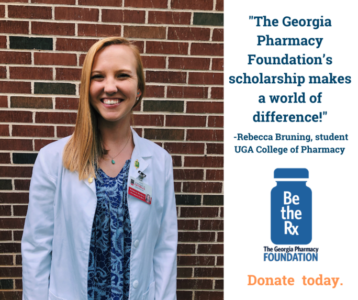
GPhF needs your help today to fund scholarships
UGA prof exposes penicillin (non) allergies
The latest in the J&J talcum powder kerfuffle
Wait on the ACE inhibitors says study
Bad news for kids
Another Census study shows a similar increase, with the uninsured rate for kids increasing to 5.5% last year, up from 5.0% two years earlier.APhA wants to know your immunization champs
October 30, 2019 ✒ Andrew Kantor
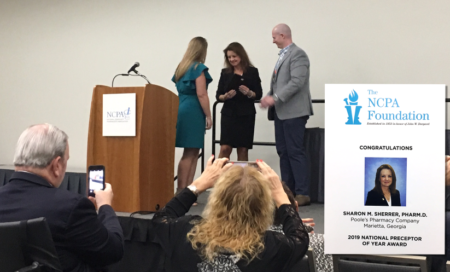
GPhA’s 2007–08 president was the recipient of the 2019 National Preceptor of the Year award from the NCPA Foundation! Here she is, accepting it at the NCPA convention in San Diego (while husband John, GPhA’s 1988–89 president, captures the moment from the front row): Its team took second place in the NCPA Student Business Plan Competition at the NCPA convention for its proposal for a new kind of independent pharmacy that would offer patients diabetes education classes, nutrition consulting, and fitness classes — in addition to the typical pharmacy services. High-five to third-year student pharmacists Lauren Brewer, Garrett Faucette, Courtney Gibson, and Makayla Winters! The cause of the Mysterious Vaping Illness has (likely) been found: It’s black market THC oils, possibly when diluted with vitamin E oil. But that puts federal health agencies in a bind. THC (other than in very small quantities) is still illegal on the federal level, even though it’s been legalized or decriminalized in most states*. That means federal regulators can’t regulate these vaping cartridges, nor does the FDA have the power to test and approve/deny products. As the Washington Post put it: ‘[W]hile THC remains illegal under federal law, the door is closed to federal agencies who might otherwise be able to evaluate how these compounds are manufactured and marketed.” A new tuberculosis vaccine, even though it’s only 50 percent effective, could save millions of lives. The current vaccine, BCG, is 98 years old and is only used in infants. The new vaccine could treat adults with latent TB as well. But, as always, there is much more testing to be done. Mylan has recalled its version of alprazolam tablets: USP C-IV, 0.5 mg in 500-count bottles, lot No. 8082708, with a September 2020 expiration date. The more you know. It’s closing about 40 percent of its small, in-store clinics in favor of either 1) the ones it runs with local healthcare providers, B) larger primary-care centers, and iii) some Jenny Craig weight loss centers. Some scientists, who apparently have never heard of bacteriophages (to target antibiotic-resistant bacteria), are instead looking at using CRISPR to edit the genes of plasmids to attack particular germs. They’re calling it the ‘next antibiotic.’ Editing genes to create killer viruses to attack bacteria*— what could go wrong? Facebook is launching a new ‘preventive-health tool,’ and it pinkie-promises that this time your personal information won’t be shared with the entire world. For reals. It’s got the best privacy tools. Everyone talks about how great its privacy tools are. Honest.Vaping-death culprit, Walgreens changes, and some big congrats to be had
Congrats to Sharron Sherrer!
And congrats to UGA!

Vaping deaths: Culprit found, but not a much can be done
* Not including Georgia, where it’s only legal in narrow cases for certain medical conditions. But you knew that.
Consumption junction?
Alprazolam recall
Walgreens to close some clinics
Reinventing the wheel … of death
* Phages already do that, and they occur naturally. The trick is finding the phage that attacks a particular bacteria. The U.S. Navy is already working on that.
Pull the other one…
October 29, 2019 ✒ Andrew Kantor
Speaking of vaping, it turns out that when you restrict the availability of flavored vaping products, teen use drops by 70 percent. (That link is to the paper. For the news story, click here.) In the wake of the Zantac/ranitidine recalls, the FDA says there are plenty of antacids it considers safe for sure: Nexium (esomeprazole), Pepcid (famotidine), Prevacid (lansoprazole), Prilosec (omeprazole), and Tagamet (cimetidine) are probably free of carcinogens. At least one in five young adults incorrectly believe that vaping is harmless and non-addictive. (The good news: “71% of adults agreed that e-cigarettes cause cancer.” So most of them are at least somewhat on the ball.) Yale researchers found a way to help people solve problems … while they sleep. The trick: Play a particular sound while someone tries (and fails) to solve a problem — they call it a “cued puzzle.” Then, while the person is asleep, play the same sound (not loud enough to wake ’em). Result: The next morning, participants solved 31.7% of cued puzzles, compared with 20.5% of uncued puzzles (a 55% improvement). Not convinced of the power of the gut microbiome? Check this out: Depending on the bacteria in their guts, mice may or may not remember to be afraid. Holy moly. “Opioids saved my life. Quitting them took five excruciating years” Finally, after seven months of cutting back, the last of my last tiny dose of opiates metabolized out of my body on July 4, 2014. […] It was one of the most triumphant days of my life, yet the empty low was indescribable. I did not know then — because no one had the guts to tell me, or maybe it would have been too cruel — that my withdrawal would only get worse.Zantac alternatives, puzzles in your sleep, teens want flavor, and more
No flavor, no vape
Dropping acid
Fantasy land
Sleep on it
Fear the disinfected gut
The Long Read: Opioid cold turkey
October 26, 2019 ✒ Andrew Kantor
It’s cheap, it’s strong, and people are desperate for it (or something like it). With the ongoing crackdown on both legal and illegal painkillers, those in pain are turning to the streets and to fentanyl — and it’s killing them. New CDC data shows fentanyl is involved in almost twice as many overdose deaths as heroin. What’s killing Georgians (part of CDC’s region 4)? Fentanyl is #1, followed by cocaine, heroin, Xanax, meth, and oxycodone. One is in the works at Georgia State University (it works on ferrets so far)… The drug tricks the virus into making genetic errors as it replicates, creating essential flaws that doom its ability to spread. “The drug mutates the virus to death, forcing the virus to make so many errors that the virus cannot live any longer.” …while the other comes from a team from several research centers (it works on mice). It’s an antibody that binds to the neuraminidase protein and prevents the flu virus from using it to replicate. Two strains of polio are virtually eradicated around the globe, but one is still out there. But anti-vaxxers have stymied the eradication program, and that has allowed mutant strains to emerge, making finally wiping out the disease tougher than ever. Retailers are pulling 22-oz. J&J Baby Powder from their shelves after it was recalled by the company. Put another way, “Recalled products are being recalled.” A team of researchers in Chicago developed a technology that allows people with celiac disease to reduce their reaction to gluten by 90 percent. It’s not a permanent treatment; it involves drinking what the team created before eating. The technology involves a biodegradable nanoparticle that “hides” gliadin — the main compound in gluten — in a shell, “tricking” the immune system into not realizing that it contains gluten. While no one is selling Zantac (or its generics) anymore — it’s been pulled from shelves around the world by governments, manufacturers, and retailers — the FDA is still investigating whether it’s safe … and hasn’t ordered a recall. Canadian researchers have found that kids who watch TV, play on their phones, or use social media are more likely to have too much sugar and energy drinks. (And why do they get hooked on sugar in the first place? “Misleading marketing.” For 10 years, the U.S. has funded a critical and innovative program to help detect animal viruses before they jump to humans. Now we’ve stopped. The program, called Predict, had strong bipartisan support… until two years ago. “Scientists Were Hunting for the Next Ebola. Now the U.S. Has Cut Off Their Funding.” “Predict was an approach to heading off pandemics, instead of sitting there waiting for them to emerge and then mobilizing. That’s expensive. “The United States spent $5 billion fighting Ebola in West Africa. This costs far less.”Canadian Captain Obvious, new celiac treatment, universal flu treatments, and more
Death by fentanyl
Two more steps toward a universal flu vaccine
The last step is a doozy
I guess it’s news
Free gluten
Go ahead, take your time
You don’t say
The Long Read: Losing an ounce of prevention
October 25, 2019 ✒ Andrew Kantor
Ranitidine, aka Zantac, that is. Perrigo is now recalling its generic version, joining the ranks of … well, a long list of countries (but not the U.S.), manufacturers, and retailers that have pulled brand-name and generic ranitidine from the shelves because it might be contaminated with a carcinogen. We know the gut microbiome is pretty darned important, and that it has widespread effects we’re still uncovering. So a finding that half of common drugs affects your gut bacteria … well, that’s something to be concerned about. And they do: Proton pump inhibitors, metformin, antibiotics, and laxatives all seem to have a significant effect, according to a pretty big new study presented at the United European Gastroenterology conference. Congrats to the folks at InpharmD — including GPhA board member Ashish Advani — who just had a paper published in the Annals of Pharmacotherapy, “Development of a Drug Information Service Collaborative in Academia.” (high five) CRISPR has a lot of promise, but it’s far, far from perfect. It can seek and cut out specific genes and replace them with others, but there’s no guarantee that the new genes will be incorporated properly. Now a new technique called “prime editing” might change that, and at the same time open the possibility of being able to cure any genetic disease. [P]rime editing could, according to [co-developer David] Liu’s calculations, correct around 89 percent of the mutations that cause heritable human diseases. Working in human cell cultures, his lab has already used prime editors to fix the genetic glitches that cause sickle cell anemia, cystic fibrosis, and Tay-Sachs disease. If you’re going to the NCPA convention in San Diego this weekend, be sure to cheer on the UGA team at the business-plan competition! They’re up against teams from the University of Oklahoma and the University of Texas at Austin. It’s Saturday, October 26, from 1:30 to 3:30 p.m. Come and see first-hand the excitement around the live presentations of the Annual Business Plan Competition. This top spot earns them a chance to win cash for their school and a complimentary trip to the NCPA Multiple Locations Conference in Florida, at the end of February and beginning of March 2020. Sadly, NCPA doesn’t have info online about this year’s competition, but click here for some general info on the event. Did you know you can offer cognitive testing for your patients? Yeah, us either — but apparently you can. So says Cognivue, maker of the “world’s first Food and Drug Administration-cleared computerized test for assessing cognitive function.” (Warning: The “article” doesn’t give a lot of info, but we liked the idea of brain tests for patients enough to share it anyway.) “In the last decade, a dangerous new front has opened in the war on polio.” In countries where vaccination rates are low, the weakened viruses in the oral vaccine can circulate in wastewater and mutate into what are effectively evil twins of themselves.CRISPR upgrade, gut biome and meds, a brain test in your pharmacy, and more
At this point you shouldn’t have this stuff on your shelves
A lot of drugs affect the gut biome
Shout out to InpharmD
Could widespread gene repair be around the corner?
Cheer for UGA at NCPA!
“You must score this high to be able to speak with a pharmacist”
The Long Read: Polio, 2019
October 24, 2019 ✒ Andrew Kantor
A new study published in the European Heart Journal says that it’s better to take hypertension meds at bedtime. That’s enough to bring to the (virtual) water cooler, but if you want the details, check out the study itself or read the news story. Tobacco is bad, period, but the FDA has — for the first time — approved a smokeless tobacco product as a better alternative to cigarettes. (“Better” being a relative term, like one broken arm is better than two.) ‘Why do we let insurance companies practice medicine?‘ asks one physician in a Washington Post editorial. And honestly, we don’t have an answer. The mysterious, polio-like illness that’s been affecting kids around the country — acute flaccid myelitis or A.F.M. — might have given up a clue about its cause: enteroviruses. Using sophisticated laboratory techniques, researchers found antibodies to enteroviruses in the cerebrospinal fluid of nearly 70 percent of the children with A.F.M., a sign their bodies had mobilized to defend against enterovirus infection. It turns out that women who breastfeed their kids for at least a year are less likely to develop either high blood pressure or diabetes. The likely reason: Breastfeeding uses a lot of calories, and the metabolic changes are especially important during and right after pregnancy. Having it means an increased risk of various infections, including influenza, cellulitis, and sepsis. Scottish researchers have determined that teenagers who use social media apps for five or more hours a day were more likely to go to sleep later.Should insurers be doctors? Plus diabetes and breastfeeding, when to take blood pressure meds, and more
Sleep tight
Chew on this
It’s not because of their bedside manner
One clue to a mystery
Diabetes and breastfeeding
Speaking of diabetes…
Someone got paid to do this study
October 23, 2019 ✒ Andrew Kantor
Not great, not terrible. The latest edition of the Occupational Outlook Handbook says that pharmacist employment overall is likely not to change over the next 10 years — i.e., growth with be zero. But… that’s because growth in jobs in hospitals and clinics will increase, offset by a decline in retail jobs. [R]etail pharmacies will be affected by increasing sales via mail order and online pharmacies. In addition, pharmacy technicians will be taking a greater role in pharmacy operations. Speaking of which, job opportunities for pharmacy technicians are expected to increase about 7% over that same period. “When Pharmacies Close, Low-Income Neighborhoods Lose” from Forbes. Walgreens has made its first “store to door” drone delivery — a pack of cold remedies sent to a family in Christiansburg, Virginia. Not to be left alone on the ground, looking wistfully at the clouds, CVS is partnering with UPS to offer its own drone-delivery service, presumably using the chain’s famous mile-long receipts to lower packages onto customers’ porches. Want a little more about the whole pharmacy-drone thing? Fast Company’s got you covered. Hot on the heels of the $260 million opioid settlement with two Ohio counties comes word of a potential $48 billion deal — an “agreement in principle” — between drug companies (AmerisourceBergen, Cardinal Health, Johnson & Johnson, McKesson, and Teva) and four states (North Carolina, Pennsylvania, Tennessee, and Texas). But … the lawyer for the 2,000+ cities, counties, towns, and tribes says it’s not enough. The deal in two sentences: If you have patients who’ve recently been diagnosed with Parkinson’s, watch out for how many meds they’re taking. A new study finds that taking too many meds appears to be linked with cognitive decline. “This is the first study to demonstrate an association between polypharmacy and cognitive decline in patients with newly diagnosed PD [Parkinson’s disease], as well as in community-dwelling older adults. […] Medication reduction might be a promising intervention to prevent the development of dementia in patients with early PD.” At this Saturday’s National Drug Take-Back Day, the DEA says it will for the first time accept vaping devices and cartridges. The opioid epidemic has cost the U.S. more than $600 billion over the last four years combating the opioid epidemic, according to a report from the Society of Actuaries. That’s money spent on emergency services, extra medical care, criminal justice, and family assistance programs*, but also includes lost wages and lower productivity. Of that $600+ billion, about $283 billion is in actual spending, so at least that’s going back into the economy — paying for products and services. But there are certainly better ways to use that cash. For 2019, the society expects the country to take an $188 billion hit. New York is now requiring pharmacists to inform their patients when a drug has been recalled. According to a justification attached to the bill, pharmacies are ideal messengers for these recalls because they often act as the most direct point of contact for patients.Walgreens starts drone strikes, flat growth for pharmacists, DEA wants those e-cigs, and more
Employment outlook
But you knew that already
Duck

Another (potential) opioid settlement
The danger of polypharmacy and Parkinson’s
Give us your tired, your hungry, your e-cigs….
The price we pay
Elsewhere: Empire State edition
Do you want to send your members the daily Buzz email newsletter (customized for your state and organization, perhaps)? Let’s talk — just drop me a note at andrew@gphabuzz.com!

- Doctors Warn of a Deadly Complication From Measles Outbreaks
- Medicare Advantage ‘Dark Money’ Group Attempts To Win Higher Payments for Insurance Companies
- Families Scramble To Pay Five-Figure Bills as Clock Ticks on Promised Preauthorization Reforms
- As Lung Disease Threatens Workers, Lawmakers Seek Protections for Countertop Manufacturers
- Republicans Fret Over RFK Jr.’s Anti-Vaccine Policies While MAHA Moms Stew
- Primary Care Is in Trouble. So Doctors Band Together To Boost Their Market Power.
- January 2025
- December 2024
- November 2024
- October 2024
- September 2024
- August 2024
- July 2024
- June 2024
- May 2024
- April 2024
- March 2024
- February 2024
- January 2024
- December 2023
- November 2023
- October 2023
- September 2023
- August 2023
- July 2023
- June 2023
- May 2023
- April 2023
- March 2023
- February 2023
- January 2023
- December 2022
- November 2022
- October 2022
- September 2022
- August 2022
- July 2022
- June 2022
- May 2022
- April 2022
- March 2022
- February 2022
- January 2022
- December 2021
- November 2021
- October 2021
- September 2021
- August 2021
- July 2021
- June 2021
- May 2021
- April 2021
- March 2021
- February 2021
- January 2021
- December 2020
- November 2020
- October 2020
- August 2020
- July 2020
- March 2020
- February 2020
- January 2020
- December 2019
- November 2019
- October 2019
- September 2019
- August 2019
- July 2019
- June 2019
- May 2019
- April 2019
- March 2019
- February 2019
- January 2019
- December 2018
- November 2018
- October 2018
- April 2017
