October 23, 2020 ✒ Andrew Kantor
Shout out to the pharmacy team at Phoebe Putney Memorial Hospital Pharmacy! For its “outstanding response during the Covid-19 pandemic,” PPMHP’s corporate director of pharmacy services, Marty Kelvas, was given the Georgia Society of Health System Pharmacists’ 2020 Outstanding Community Volunteer Service Award. Note: Technically this is Covid-free Friday, but these folks — and, let’s face it, a heck of a lot more of you all — deserve the kudos. It seems that smoking a joint can reduce the symptoms of OCD — or so report Washington State University researchers. (Marijuana is fully legal out there.) After smoking cannabis, users with OCD reported it reduced their compulsions by 60%, intrusions, or unwanted thoughts, by 49% and anxiety by 52%. Interesting notes: First, it only appears to result in short-term relief. Second, the higher the concentration of CBD — not THC — the greater the effect. “The results overall indicate that cannabis may have some beneficial short-term but not really long-term effects on obsessive-compulsive disorder,” said the lead author, but, “To me, the CBD findings are really promising.” 1) If you eat soy products — and have the right gut biome — it could reduce your risk of dementia. Subjects in a Japanese study whose gut bacteria produced equol* from digesting soy “display lower levels of white matter lesions within the brain.” 2) IBM and Pfizer have trained an AI to detect signs of Alzheimer’s from — ready? — patients’ writing samples. And it’s 70 percent accurate. How’d they do it? With data from the Framingham Heart Study, “which has been tracking the health of more than 14,000 people from three generations since 1948.” IBM says its main AI model was able to detect linguistic features that are sometimes related to early signs of cognitive impairment. They include certain misspellings, repeated words and the use of simplified phrases rather than grammatically complex sentences†. After a fracture, the chance of reinfection or additional surgery is no worse with oral antibiotics than with those given by IV. Simple enough, right. But, if you want to sound all science-y, put it this way: “With associated congruent reinfection and reoperation rates, oral antibiotics are noninferior to IV antibiotics for fracture-related infections.” I have to wonder: After a first date, would this guy say, “I find our initial congruent temporal association to have been noninferior to comparable experiences”? Probably. “High flavanol diets may lead to lower blood pressure” — from the University of Reading. “People who consume a diet including flavanol-rich foods and drinks, including tea, apples and berries, could lead to lower blood pressure.” “Drinking green tea and coffee daily linked to lower death risk in people with diabetes” — from Kyushu University. Drinking four or more cups (i.e., two or more typical mugs) of green tea and at least one mug of coffee was “linked to 63% lower all cause mortality.” Someday soon you might be able to have the skin of a newborn, and not in a creepy way at all. Washington State University researchers have found a genetic factor “that acts like a molecular switch in the skin of baby mice.” The switch is mostly turned off after skin forms and remains off in adult tissue. When it was activated in specialized cells in adult mice, their skin was able to heal wounds without scarring. The reformed skin even included fur and could make goose bumps, an ability that is lost in adult human scars. Don’t get too excited, though: “A lot of work still needs to be done before this latest discovery in mice can be applied to human skin, but this is a foundational advance.” Congress wanted to help the hemp industry. Hemp isn’t marijuana, although they are related. So in the Agriculture Improvement Act (AIA) of 2018 it removed hemp from the definition of marijuana, and gave control of regulating hemp from the DEA to the U.S. Department of Agriculture. If it has a THC concentration of “not more than 0.3 percent on a dry weight basis,” it was considered “hemp” and regulation went to USDA. The pharma connection: This also applies to CBD products. And in 2019, the DEA told industry that … … after a review of the AIA, it determined that synthetic cannabinols (CBD) containing less than 0.3% Δ9-THC met the definition of “hemp” and therefore were no longer scheduled drugs under the CSA. So synthetic CBD was also cool, as long as it had little to no THC. But now DEA has issued a interim final rule … and seems to be saying the opposite. Any synthetically derived tetrahydrocannabinols, it said, remain schedule I drugs, even if the THC is less than 0.3%. “For synthetically derived tetrahydrocannabinols, the concentration of Δ9-THC is not a determining factor in whether the material is a controlled substance.” Thus, all synthetic forms of cannabis and its derivatives, regardless of the Δ9-THC content, are still subject to DEA control. So a lot of CBD makers — not to mention hemp growers and producers — are very, very upset, especially since the DEA skipped the whole ‘notice and comment’ period to let people know about this. Cue the lawsuits.Hemp confusion, a doobie for OCD, green tea and coffee, and more
High-five* for Phoebe
* Virtual. No touching.
Cannabis vs OCD
Two dementia stories
* “An isoflavandiol estrogen metabolized from daidzein,” as you undoubtedly knew
† Yes, feel free to make jokes about the candidates of your choice. We all know that’s where your mind went.Antibiotics: Oral works just fine
Dietary news
Eat me
Drink me
Skin in the game
CBD, hemp, and what the DEA is saying
October 22, 2020 ✒ Andrew Kantor
On October 20, the U.S. Centers for Disease Control finally said that it recommends masks be worn on all public transportation. No, it won’t mandate them — but after seven months of consideration, the agency is now recommending them. Most U.S. airlines, Amtrak, and many other transport companies already require passengers and staff to wear masks. But wait, there’s more! The CDC has also changed its guidance about what constitutes “close contact” with an infected person. Then: Spending 15 minutes or more within six feet of someone who was infectious. Now: Spending a cumulative 15 minutes or more within six feet of someone who was infectious in the past 24 hours, even if the time isn’t consecutive. Purdue Pharma plead guilty to the criminal charges of how it marketed Oxycontin even as the opioid epidemic spread. The penalty*: $8.3 billion. And the Sackler family will pay $225 million as part of a civil settlement. But this is just one case — the company is still on the hook (and yes, criminal charges may yet be filed against Purdue executives or individual Sacklers). This federal case against Purdue is distinct from thousands of opioid-related lawsuits against other drug manufacturers, as well as distributors and pharmacy chains, still pending in federal and state courts. Penn State researchers have found that diluted baby shampoo (1%) used as a nasal rinse kills the SARS-CoV-19 virus. Most mouthwashes (used orally, not in the nose!) also do the trick if you use them long enough — like, for two minutes. The supply chain’s been an issue since Covid-19 started spreading (think toilet paper and Lysol). But WellStar wasn’t hit so badly, and doesn’t plan to have issues during a second wave, either. Becker’s Hospital Review has an interview with the guy who oversaw the planning — Michael McCullough, senior vice president of supply chain. First its Covid vaccine test was halted. Now FDA inspectors didn’t like what they saw at the company’s Branchburg, N.J. plant that’s making bamlanivimab. It recommended that Lilly receive a Strongly Worded Letter™ about the conditions. In an Oct. 2 memo, Food and Drug Administration compliance officers wrote that findings from an inspection of the facility in July and August “support a major failure of quality assurance.” They noted that Lilly planned to make its antibody therapy at the plant and said the inspection group “feels it is still imperative that FDA take action.” Georgia has 159 counties, and 159 probate judges. One in 10 has contracted Covid-19, and three have died so far. Penn State researchers are working on on-skin printing of sensors that could monitor vital signs. And once every American submits to this electronic tattoo, it can be used to warn of, say, Covid-19 symptoms. Almost as cool as a barcode on the forehead “[American Psychiatric Association] poll shows 62% of Americans more anxious now vs. this time last year“. From 2017 through 2019, 65.3 percent of women used contraception. Of note: That broad term includes female sterilization (18.1%), oral contraceptives (14.0%), long-acting reversible contraceptives (10.4%), and condoms (8.4%).Shampoo in your nose, sensors on your skin, Purdue pleads guilty, and more
You don’t say
No more “allegedly”
* Or “the cost of doing business,” if you’re cynical
The 1% solution
WellStar’s ounce of prevention
Lilly’s bad week continues
Yikes
This won’t get the conspiracy theorists yappin’

Something is wrong with 38 percent of Americans
Stat of the day, from the CDC
October 21, 2020 ✒ Andrew Kantor
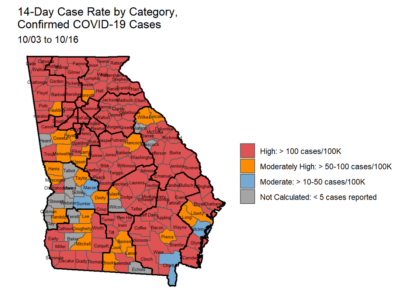
It’s not like there’s a clear boundary, but it looks like Covid-19 cases are picking up again. Although the article mentions Bibb and five other Middle Georgia counties, there’s definitely an uptick going on: It’s not just Georgia — in a lot of the country, hospitals are gearing up: “New surge of Covid-19 cases has states, hospitals scrambling, yet again” Ophthalmologists are concerned that “Increased digital screen time during Covid-19 may accelerate myopia epidemic.” (Today I learned that lots of people being nearsighted is a “myopia epidemic.” Next up: “Lockdowns, apathy increasing body odor epidemic.”) Pharma twist: The FDA may approve a low-dose version of atropine, and at least one ophthalmologist (the one who got to write an article) “I anticipate a large increase in [atropine] prescriptions written for myopia control.” The latest figures from CMS show that the average (typical?) Obamacare plan — i.e., one bought through the exchange — will cost about two percent less in 2021. That’s the base price, of course; most people get a subsidy to cover some or all of the cost. Stick patients with pins! No, really. “A new pilot study concludes that using acupuncture before surgery can reduce a person’s need for opioids following surgery.” People in the control group needed an average of 56 of morphine milligram equivalent (MME) in the first 24 hours after surgery. In comparison, those who had traditional acupuncture received an average of only 20.4 MME. Almost two-thirds less than the control group. The Brits are considering infecting healthy people with SARS-CoV-2 — a challenge trial. But the first one won’t be to test a drug. It’ll just be to make people sick: “[T]he aim will be to discover the smallest amount of virus it takes to cause a person to develop COVID-19.” After that study is done, they’ll start infecting people who have been vaccinated to test the vaccine(s). Dutch scientists, rooting around inside some patients’ heads, found themselves a new organ: “a pair of large salivary glands, lurking in the nook where the nasal cavity meets the throat.” Anatomy books all say there are three salivary glands, so if this proves true, it’ll be the first update in 300 years — and a chance for textbook makers to raise their prices by 35%. The new find might help explain why people who undergo radiation therapy for cancer of the head or neck so often end up with chronic dry mouth and swallowing problems. Because these obscure glands weren’t known to doctors, “nobody ever tried to spare them” from such treatments. Spoiler: It’s not just about politics. Now, 10 months into the crisis, many fear the CDC has lost the most important currency of public health: trust, the confidence in experts that persuades people to wear masks for the public good, to refrain from close-packed gatherings, to take a vaccine. “Study Shows Active Older Adults Have Better Physical and Mental Health“New gland in your head, myopia epidemic, the power of pins, and more
The second wave — is it here?
Sheesh, another epidemic?
Obamacare premiums to decline for 2021: CMS
Wanna cut down on opioid use?
I’m gonna pass on this one
Brand new gland
The Long Read: “Inside the Fall of the CDC”
Captain Obvious sings the same old song
October 20, 2020 ✒ Andrew Kantor
In the Before Times we would have suggested hugging a tech (or two) today, but now we can only recommend an extra-friendly wave from across the room. Happy Pharmacy Technician Day! Not all heroes wear capes (but they all wear masks) The FDA would like to remind you that you should keep insulin pens in their original boxes — dispense them to a single patient in that sealed carton. “[I]ndividual insulin pens with different dosages or formulations often have similar appearances that can be difficult to distinguish.” Do you have older mice patients who are looking frail? You might consider giving them some major doses of vitamin D. A study out of Buffalo University found that “frailty can be slowed with what might be considered ‘over’ supplementation with vitamin D, referred to as ‘hypersufficiency’.” Even mice that had good vitamin D levels throughout life had problems when their D levels were decreased in old age. “We found that in aged mice, low levels of vitamin D result in physical declines, such as reduced grip strength and grip endurance — the ability to sustain a grip — and that they started developing as soon as one month after reduction of vitamin D intake.” A study of 732,199 people found that those who used aspirin, metformin, or statins — or better yet, more than one of those — had a lower risk of dying from lung cancer. But say it with me: “Further studies are necessary.” Aussie scientists have just found a cool way the human body fights infection: Shooting blobs of fat at invaders. Yes, technically they’re “lipid droplets,” but “fat blobs” is much more entertaining. It seems that bacteria will feed on these lipids, so cells have learned to pack them with poison. “[C]ells manufacture toxic proteins, package them into the lipid droplets, then fire them at the intruders. This is a new way that cells are protecting themselves, using fats as a covert weapon, and giving us new insights into ways of fighting infection.” Artist’s conception Conventional wisdom says that you can give kids a sugar rush. Science has said it’s not true. It seems that science may have spoken too soon: New research from the University of Colorado has found that yes, fructose might trigger “manic behaviors” including ADHD. In short, fructose (they say) lowers cells’ energy levels, triggering “foraging response similar to what occurs in starvation.” That response — the quest for food — “stimulates risk taking, impulsivity, novelty seeking, rapid decision making, and aggressiveness.” Existing drugs might help: amodiaquine, nebivolol, and zuclophentixol cleared the SARS-CoV-2 virus … from test tubes. Deaths at home: “Georgia surpasses 7,500 COVID-19 related deaths.” Georgia: The state “faces enormous challenges to distribute a COVID-19 vaccine.” (Spoiler: So does every state.) CVS: It’s pushing for the federal government to allow pharmacy technicians to give the eventual Covid-19 vaccine(s). A new way of delivering drugs where you need them might be microscopic robots. Using magnetic fields, Purdue University researchers were able to send one tumbling through the colon (yes, there’s cool video) where — in theory — it could be directed to a specific location to release its medical payload. Getting a drug directly to its target site could remove side effects, such as hair loss or stomach bleeding, that the drug may otherwise cause by interacting with other organs along the way. Money quote: “The researchers chose the colon for in vivo experiments because it has an easy point of entry – and it’s very messy.”Fat guns, colon robots, lung cancer prevention, and more
Celebrate your techs!
Insulin: Keep it in the box
“D” is for “Don’t stop taking it when you get older”
Basic meds fight lung cancer
Fat grenades fight infection

If you give a mouse a cookie … it might get manic
Covid notes
Is that a robot in your colon?
October 17, 2020 ✒ Andrew Kantor
Women who are more than 20 weeks pregnant may face risks from NSAIDs, and the FDA will be requiring new warning labels on both OTC and prescription NSAIDs. [T]he drugs can cause rare but serious kidney problems in the unborn baby, which can lead to low levels of amniotic fluid (the protective cushion surrounding the unborn baby) and the potential for pregnancy-related complications. The warning does not apply to low-dose (81mg) aspirin. Bullet points on the plan announced by Governor Kemp: Georgia Health News has a more detailed breakdown of the plan. If you been waking up thinking, “I bet resurfacing the duodenum could eliminate the need for insulin,” Dutch researchers may have proven you right. It seems that the minor surgery — when combined with a GLP-1 receptor agonist — may allow patients to stop taking insulin. It’s a small study, and it might be because of the weight loss, but “Six months after treatments began, three-quarters of participants taking insulin no longer needed it.” “We think the effects result from a combination of changes that occur when the duodenal mucosa is ablated and rejuvenated. We think that changes in hormonal signaling, including the gut hormone GLP-1, bile acid compositions and the microbiome play an important role.” Georgia State researchers have found a common vulnerability among at least three coronaviruses (SARS-CoV-1, SARS-CoV-2, and MERS). That, they say, could be a pathway to “broad coronavirus inhibition” — aka, fighting all sorts of similar viruses if (when) they appear. They’re bacon scented, from Hormel. Using the latest in bacon-smell technology and irresistibly breathable, 2-ply fabric, finally, bacony-bliss can be with you always — even while out in public. Downside: It’s only two plies. The headline says it: A liquid biopsy test for blood can detect the genetic mutations that indicate the presence of gliomas — the most common type of brain tumor. The test can accurately detect mutations of the TERT gene — mutations that “are present in more than 60 percent of all gliomas, and in 80 percent of all high-grade gliomas, the most aggressive and life-threatening type.” Computers can learn to detect Lyme disease from pictures of rashes. Yep, in theory this means you’ll be able to send a pic of the rash to … well, someone, who can then have it evaluated by an AI to help decide if you need treatment. Evaluating the public domain images, the computer-enhanced image analysis system had an accuracy ranging from 72%, when choosing between [Lyme disease erythema migrans (EM)] and other rashes, to 94% when picking out EM from normal skin. Amusement factor: The Johns Hopkins PR people call these “rash selfies,” but — last we checked — most rashes can’t take pictures of themselves. The Mighty Os: Further proof that people with type O blood are less likely to get the coronavirus or develop severe complications comes from two separate studies. Window of safety: Immunity lasts at least several months, but may not be permanent. Remdesivir fails: It may shorten recovery time in mild cases, but it doesn’t lower the risk of death — nor delay ventilator use. That comes from a large, international study to be published in the NEJM. Say what? “Covid-19 linked to sudden hearing loss” — well, one person had it happen, and now the Brits as asking others to keep a lookout. Mmmm — bacon mask, NSAID pregnancy risk, surgery for diabetes, and more
IMPORTANT: NSAIDs and pregnancy
Georgia to add 65K to Medicaid
* Work, community service, job training, and some other activities are included
Minor surgery instead of insulin?
Georgia State finds a coronavirus weakness
The masks you’ve been waiting for

Blood test for brain tumors
Lyme detector
Covid notes
October 15, 2020 ✒ Andrew Kantor
“The proportion of Americans dying from coronavirus infections is the highest in the developed world.” While we started off with a lower mortality rate, “as spring turned to summer, the U.S. largely failed to embrace public-health and policy measures that have helped other countries reduce death rates.” (We also lead the world in total number of deaths.) And “U.S. Covid-19 Hospitalizations Hit Highest Level in Nearly Six Weeks” — and hospitals are reporting surges. The Long Read — A Dose of Optimism: “The months ahead will be difficult. But the medical cavalry is coming, and the rest of us know what we need to do.” As we launch this campaign, we remember Jim Bartling, our foundation chair who recently and unexpectedly passed away. He was a person with a big heart and a giant legacy of helping others, and he leaves a sizeable void here at the foundation. Thanks to Jim’s vision, the Georgia Pharmacy Foundation’s PharmWell initiative promotes mental wellness in our profession, including challenges such as burnout, drug abuse, depression, and suicide. Some pharmacists have described PharmWell’s programs as “life changing.” If you’d like to take a moment to honor Jim, please share your memories and appreciation of Jim online. UPenn researchers sent their grad students out to play with highly toxic Korean yellow-jacket wasps, and the result: a protein that can be tweaked so it kills bacteria (usually) without harming human cells (usually). So far they’ve only experimented on mice, though, but their new protein shows promise in protecting those mice from lethal bacterial infections. Even with this potentially useful protein, the official position of GPhA Buzz (although not necessarily GPhA itself) is that all wasps should be destroyed on sight. It declared bankruptcy, “saddled with lawsuits alleging it fueled the U.S. opioid epidemic and after it lost a court battle to avoid paying higher rebates to state Medicaid programs for its top-selling drug.” The trial of a monoclonal antibody treatment that works with remdesivir was paused by U.S. health regulators — the data safety monitoring board — for undisclosed safety concerns. It’s a pause, not a cancellation, but it does come on the heels of a pause of the J&J vaccine trial. Two more companies — Marksans Pharma and Sun Pharmaceutical Industries — bring the total number to at least 10 who have recalled the extended-release version of metformin because of high levels of a carcinogen. Useful wasps, good and bad Covid news, bankrupt drugmaker, and more
The bad Covid-19 news
The good Covid-19 news
Remembering Jim Bartling
Wasps may be good for something
Guess you can cross Mallinckrodt out of the phone book
Lilly pauses its Covid-treatment trial
Metformin recall widens
August 01, 2020 ✒ Andrew Kantor
When it comes to Covid-19, little kids are like walking bombs. A study in JAMA Pediatrics found that kids younger than five who have Covid-19 typically have milder symptoms … but carry a lot more of the SARS-CoV-2 virus in their upper respiratory tract. Thus, young children can potentially be important drivers of SARS-CoV-2 spread in the general populatio. […] Behavioral habits of young children and close quarters in school and day care settings raise concern for SARS-CoV-2 amplification in this population as public health restrictions are eased. This could be huge (and, in a way, a little disturbing): A new blood test appears to detect colorectal, esophageal, liver, lung, and stomach cancer four years before any symptoms appear. It’s got a 90 percent accuracy rate (but five percent false positives). That can mean a big head start for treating fast-moving cancers. Obviously this is new, still in the lab, and not ready for widespread use. But keep an eye out for “PanSeer test” to see where it goes. Yesterday we told you about Dawn Baker, the Georgia news anchor who’s helping test a Covid-19 vaccine. Well guess what? You can join her! Yep, the U.S. government’s COVID-19 Prevention Network is looking for test subjects for upcoming vaccine candidates. The CDC may not always treat you like a healthcare provider, but it’s happy to have you as a guinea pig! If you know someone who’s gotten addicted to cannabis — which, let’s face it, is probably a little easier these days — there might be a fairly simple solution: CBD. Yep, even if THC is what drives the craving, taking daily doses of CBD can help get past it… at least according to a study out of the University of Bath in England. [P]reliminary findings indicate that a daily dose of 400 or 800 milligrams helps people with the condition abstain from using the drug, researchers said. What’s notable is that (surprisingly) this is the first truly blind study to look at how CBD alone affects THC withdrawal. Prediabetics who took 500mg of cinnamon twice a day (for 12 weeks) had their fasting plasma glucose remain stable, and their primary glucose decrease — neither of which happened to those who took a placebo. So concluded researchers from the Joslin Diabetes Center in Boston and Kyung Hee University in Korea. So … well, there you go. “Parents with children forced to do school at home are drinking more” Feeling stressed? Can’t imagine why. Some good news, though: Taking a break from making great chocolate (and cheese), Swiss researchers have determined that the more often you laugh, the less stressed you feel — i.e., the less that “stressful events” bother you. And it’s the frequency, not the intensity — so a chuckle, snicker, titter, or snigger is as good as a guffaw, roar, or full-on chortle. What’s brown and sticky? A stick! Researchers looking at more than 50 years’ worth of studies have concluded that you need to eat more chocolate — it’s good for your heart. Or, in science-y terms: “[W]e found that chocolate consumption (>1 time per week or >3.5 times per month) is associated with a reduced risk of [coronary artery disease].” But why? Well, they’re not sure. Best guess is that it’s those micronutrients; flavanols (e.g. catechin, epicatechin, and procyanidins), methylxanthines, polyphenols, and stearic acid all have been shown to do good for the CV system. Honestly, does it matter? You had me at “you need to eat more chocolate.”Cinnamon, chocolate, deadly toddlers, and more
Nasty, brutish, and short
Cancer: a four-year head start?
Want to test a Covid-19 vaccine?
Hair of the dog
Cinnamon vs. prediabetes

This is probably not what they were thinking.
STOP THE PRESSES
Smile, and the world smiles with you

And speaking of chocolate
July 30, 2020 ✒ Andrew Kantor
It ranked #3 among American colleges for cases of Covid-19, behind the University of Texas in Austin and the University of Central Florida. Georgia Tech ranked #14 — you can see the whole list over at the New York Times.) Scammers have a new trick: Faking a DEA number with their Caller ID, calling people, and demanding money with the threat of revoking their licenses. “Registrants should be aware that no DEA agent will ever contact members of the public by telephone to demand money or any other form of payment or threaten to suspend a registrant’s DEA registration,” says the agency. If you get such a call, use DEA’s “Extortion Scam Online Reporting” tool to let them know. Then don’t bother to think about what happens to someone who impersonates a federal agent. Dawn Baker, a news anchor at WTOC in Savannah, is the first person to receive an experimental Covid-19 vaccine (this one is from Moderna and the National Institute of Allergy and Infectious Diseases). “We all sit around and we think that we’re helpless, we can’t do anything. We wear our masks, we stay away from people, but we really have seen that that’s not really enough. So I thought that it was an amazing opportunity to be a part of the solution.” (Scroll down for more Covid-19 vaccine tidbits.) If you think you’re doing your dog a favor by feeding it raw food, think again. While Fido may really like it, that raw food (researchers found) can carry a host of drug-resistant bacteria. All nine of the raw food samples tested positive for multidrug-resistant enterococci, while only one of the wet food and none of the dry food samples had lineages resistant to antibiotics. So next time you shun that Purina One in favor of some artisanal raw victual, ask yourself who will take care of your pets while you’re recovering in the hospital? What happens when you mix ZZ Top, “Deliverance,” flying rocks, and Georgia pharmacists? You get “Ready. Aim. Phire!” — the Georgia Pharmacy Foundation’s amazing clay-shootin’ fundraiser featuring beer, shotguns, golf carts, and an airtight liability waiver. Meet Mike. BIG Mike. He’ll be your guide at the Big Red Oak Shooting Preserve — just an hour or so south of Atlanta in the town of Gay. Big Mike’s got huge tracts of land (2,500 acres of primeval hunting land, to be specific), so no wonder it’s favorite sporting destination for outdoor lovers. In this case, the prey is clay: clay sporting pigeons. It’s an afternoon of taking out your frustrations on flying hunks of ceramic, while you hang out (dare we say “network”?) and have a great day away from 2020. It’s Friday, September 25, 2020, from 1:00 to 5:30 pm. Single players and foursomes are welcome, and survivors can enjoy a raffle, BBQ, and beer at the end of the day. Sign up today at GPhA.org/ready-aim-phire! Boom boom boom! What will be the biggest-selling drugs in five years? The data geeks at EvaluatePharma think they know. Merck’s Keytruda and Bristol Myers Squibb’s Opdivo top the list, but you’ll have to click the link to see all 10. If you have a few minutes to kill and are curious whether artificial sweeteners are good or bad … well, don’t bother with this HealthDay article. It spends 700 words to say “We don’t know.” Do these people not know what year it is? Why, in the name of all that’s holy, would anyone even think to “Awaken Deep Sea Bacteria After 100 Million Years“? Despite needing oxygen to survive, the bacteria were able to make due with only trace amounts and almost no food for more than 100 million years. Once reanimated, most of the microbes were able to feed and multiply with seemingly no ill effects attributed to their long period of rest. Onion and garlic aren’t just for making sure no one sits next to you in a meeting. It seems that “1,000-Year-Old Onion And Garlic Remedy Kills Antibiotic-Resistant Biofilms in The Lab.” Specifically, the recipe calls for “garlic, onion or leek, cow bile, and wine.” And researchers — brave researchers — tested the salve and found that indeed, it not only kills Staphylococcus aureus, it smashes through the biofilms the bacteria uses to protect itself. It worked on monkeys, so Johnson & Johnson is moving to human trials for its vaccine. In an unusual and welcome move, the U.S. government has committed to buying 100 million doses of whatever vaccine finally emerges. “It’s a gamble, but a reasonable one,” said Dr. Walter Orenstein, an epidemiologist at Emory University who worked for the Clinton administration as director of the United States immunization program. “What the government is doing here, which I think is a good thing, they’re helping gear up production so that if this vaccine is licensed, it will be available in large quantities.” The Long Read: Having a vaccine is one step; distributing it is going to be another big one. Now is when we should be preparing.Ancient bacteria, embarrassment for UGA, a new use for cow bile, and more
UGA leads Georgia Tech … but not in a good way
That’s probably not the DEA calling you
We’re with you, Dawn!

Sup-sup-suppertime (with a side of bacteria)
It’s clay shootin’ time!

Polishing the crystal ball, pharma style

Sorry, no answer
“I wonder what’s in here” —Pandora
It’s called “Bald’s eyesalve”
Covid-19 news, vaccine edition
July 29, 2020 ✒ Andrew Kantor
In the Before Times, the health risks of vaping were big news. Then came the pandemic, and we had bigger problems. But vaping is over, right? HA! In fact, vaping injuries are climbing as people turn to drugs to help cope with pandemic stress. … and — fun fact! — vaping lung injuries share eight of 10 symptoms with Covid-19. Thanks, 2020. Before you use your Eastman Kodak stock certificates to start the grill*, wait just a moment**. Guess who just got a $765 million loan under the Defense Production Act to start producing ingredients for generic drugs? Yep, Kodak. You can’t argue that the company knows chemicals, so now it’s going to make both “starter materials” and active pharmaceutical ingredients — eventually hoping for that to account for 30 to 40 percent of its business… at least until hipsters discover Tri-X. (The idea, of course, is to reduce U.S. reliance on Chinese ingredients.) First, the big one (well, hopefully): A new, cheap blood test “very, very accurately predicts who’s got Alzheimer’s disease in their brain, including people who seem to be normal.” Important notes, though: Second, two separate studies found that A) the flu vaccine and B) pneumococcal vaccine both appear to reduce Alzheimer’s risk. The researchers found having one flu vaccination was associated with a 17% reduction in Alzheimer’s incidence. Those who were vaccinated more than once over the years saw an additional 13% reduction in incidence. If you happen to get an unlabeled packet of seeds from China (as some Georgians already have), don’t plant them. No one knows what they are or why people are getting them. “FDA Reiterates Warning About Dangerous Alcohol-Based Hand Sanitizers.” When you have a moment, check out the updated list on the FDA’s site. (Pro tip: Use the search box or you’ll be clicking forever.) “What’s up with all those vaccines?” you ask. In the movies, it takes Our Hero 20 minutes to make one! UPI has your reality check with “Quest for COVID-19 vaccines: Where they stand“. Meanwhile, Georgia added 4,293 cases and 54 deaths in one day. The state is in the “red zone” for another week (along with 20 others) because it reported more than 100 new cases per 100,000 people. In the Long Long Ago, drug overdoses in the U.S. were skyrocketing. Then they started to fall as we fought the opioid crisis, with a big dip in 2018. But no longer — 2019 had a five percent jump in OD deaths over 2018, and 2020 is on track to be 13 percent higher than that. The recent deaths aren’t as much from prescription opioids — a large portion are from meth, cocaine, and fentanyl. Side note — don’t forget to the naloxone: As part of its updated opioid labeling requirements, the FDA recommends that talking about naloxone with patients or caregivers be “a routine part of prescribing these medicines.” And, we assume, a part of dispensing them.Kodak’s back, baby! Plus vaping injuries, super Alzheimer’s test, and more
Remember vaping?
Brownie points
* If you use a gas grill you’re not grilling, you’re just cooking outside.
** I didn’t make the obvious “Kodak moment” joke. You’re welcome.Two pieces of good Alzheimer’s news
Do you want triffids? This is how you get triffids
Did you hear us the first time?
Today’s CoviD-19 updates
The Long Read: Remember drug overdoses?
March 21, 2020 ✒ Andrew Kantor
From the DCH: The GA Department of Community Health is temporarily waiving early refill limits on 30-day prescriptions for maintenance medications at any in-network pharmacy. You may now fill maintenance medication prescriptions ahead of schedule. In addition, please be advised that for prescriptions delivered during this period, DCH will not require patients to sign for the delivery of their medications. The big event for pharmacy techs — GPhA’s first annual TechU conference, networking, education, and golf event — has been rescheduled for October 24. It’ll be a full day and a great way to get some CE credits, meet your peers, talk about the job, and chill, all for $30 thanks to our amazing sponsors. (It’s $50 for non-members, though.) Check out GPhA.org/techu for all the details! A recent article in the Lancet suggested that ACE inhibitors might make someone more susceptible to the coronavirus. But with that in mind, both European and American cardiology societies have issued statements: Don’t discontinue ACE inhibitors or ARBs. We understand the concern — as it has become clear that people with cardiovascular disease are at much higher risk of serious complications including death from COVID-19. However, we have reviewed the latest research — the evidence does not confirm the need to discontinue ACE inhibitors or angiotensin-receptor blockers (ARBs). As the U.S. continues to lag in coronavirus testing, researchers at the Georgia Esoteric and Molecular (GEM) Laboratory at the Augusta University Medical College of Georgia Department of Pathology* have developed a CoviD-19 test of their own — one that gives results in only two hours. Even better, because the GEM lab is CLIA certified, it does not need FDA approval to conduct CoviD-19 tests (but it still submitted the test for FDA approval). “We completed our COVID-19 assay validation on Sunday and immediately submitted the documentation to the FDA for their approval. This was a nonstop 90-hour effort by the phenomenal team in the GEM lab to develop this test, but we all felt a commitment to our community to make this test available here.”— Lab director Ravindra Kolhe. But you knew that already. The problem is that they’re getting harder to come by — something that’s hitting hospital pharmacies and compounders particularly hard. Pharmacist Michael Ganio of the American Society of Health-System Pharmacists: “[W]e had some very concerned members who indicated that they’re in danger of running out. Over half said their institution has implemented a conservation plan. It’s something that’s very concerning.” Both too much sleep and too little are bad for your heart — so find Yale researchers after studying 1,752 Greeks. People who slept fewer than six hours or more than eight hours a night “had significantly greater odds of having plaque buildup in the walls of their carotid arteries.” But why? “We don’t fully understand the relationship between sleep and cardiovascular health. It could be that sympathetic nervous system withdrawal or a slowing [of this system] that occurs during sleep may act as a recovery phase for [usual] vascular and cardiac strain.” Yesterday I mentioned some drugs that were being looked at for treating CoviD-19. Stat News now has the full list of what’s in trial and at what stage. Spoiler: The most promising treatment is remdesivir (phase 3 trial) and a danoprevir/ritonavir cocktail (phase 1 trial). Chloroquine is not yet on the list because it’s not part of a clinical trial. Soon, probably, but not yet. Science can only work so quickly.) The most promising vaccines are in the hands of Moderna and CanSino, both of which are in phase 1 trials. A bunch of other companies are also working on them. Self-quarantined or isolated? Good. Got a dog with you? Even better, it seems. Trigger warning: Psychologist’s photo is way over-filtered. Ease up there, Evan. One thing we know is that sitting around worrying doesn’t do much good for our mental health. So, refocusing our mental energy on something positive, like playing with your pup or taking a walk together could bring welcome relief at a time like this. The death rate from “aggressive melanoma” dropped 17.9% from 2013 to 2016. And it’s not just that people are being smarter about sunscreen. It’s medical science, baby! It dovetailed with introduction of 10 new skin cancer therapies that either use the body’s immune system to fight the disease or target melanoma cells directly. From the Rome News-Tribune: “Editorial: Hey, anti-vaxxers, are you ready to get your shots yet?” Greek researchers have concluded that, even if you go vegetarian, junk food is still not healthy. “Copper Destroys Viruses and Bacteria. Why Isn’t It Everywhere?” Answer: It’s not as cheap as stainless steel and plastic… which, sadly, are not only the surfaces found in most healthcare facilities, it’s where viruses last longest. Good news: It’s not that expensive, it’s easily recycled, and it never stops killing. When a microbe lands on a copper surface, the copper releases ions, which are electrically charged particles. Those copper ions blast through the outer membranes and destroy the whole cell, including the DNA or RNA inside. Because their DNA and RNA are destroyed, it also means a bacteria or virus can’t mutate and become resistant to the copper, or pass on genes (like for antibiotic resistance) to other microbes. And with that, I leave you in the capable hands of Liddy Cronan; she’ll start with Tuesday’s edition while I’m cleaning out my (virtual) GPhA desk next week. It’s been fun, and I hope you’ve enjoyed reading as much as I’ve enjoyed writing. So until next time … good night, and good luck. I stand relieved. —AndrewWhat will anti-vaxxers do? Plus refill limits waived, emotional support dogs, and more
Early refill limits waived
TechU rescheduled
Don’t stop hypertension drugs
Augusta U has a test
* I really hope they have a wide enough door to fit that name.
Pharmacists use masks too
Goldilocks needs to set her alarm
CoviD-19 drug list follow-up
Your dog can help
Starting to win the melanoma war
Just gonna leave this out there
Shocking medical news
The Long Read: You got me, copper
Ms. Cronan has the Buzz
Do you want to send your members the daily Buzz email newsletter (customized for your state and organization, perhaps)? Let’s talk — just drop me a note at andrew@gphabuzz.com!

- Doctors Warn of a Deadly Complication From Measles Outbreaks
- Medicare Advantage ‘Dark Money’ Group Attempts To Win Higher Payments for Insurance Companies
- Families Scramble To Pay Five-Figure Bills as Clock Ticks on Promised Preauthorization Reforms
- As Lung Disease Threatens Workers, Lawmakers Seek Protections for Countertop Manufacturers
- Republicans Fret Over RFK Jr.’s Anti-Vaccine Policies While MAHA Moms Stew
- Primary Care Is in Trouble. So Doctors Band Together To Boost Their Market Power.
- January 2025
- December 2024
- November 2024
- October 2024
- September 2024
- August 2024
- July 2024
- June 2024
- May 2024
- April 2024
- March 2024
- February 2024
- January 2024
- December 2023
- November 2023
- October 2023
- September 2023
- August 2023
- July 2023
- June 2023
- May 2023
- April 2023
- March 2023
- February 2023
- January 2023
- December 2022
- November 2022
- October 2022
- September 2022
- August 2022
- July 2022
- June 2022
- May 2022
- April 2022
- March 2022
- February 2022
- January 2022
- December 2021
- November 2021
- October 2021
- September 2021
- August 2021
- July 2021
- June 2021
- May 2021
- April 2021
- March 2021
- February 2021
- January 2021
- December 2020
- November 2020
- October 2020
- August 2020
- July 2020
- March 2020
- February 2020
- January 2020
- December 2019
- November 2019
- October 2019
- September 2019
- August 2019
- July 2019
- June 2019
- May 2019
- April 2019
- March 2019
- February 2019
- January 2019
- December 2018
- November 2018
- October 2018
- April 2017
